



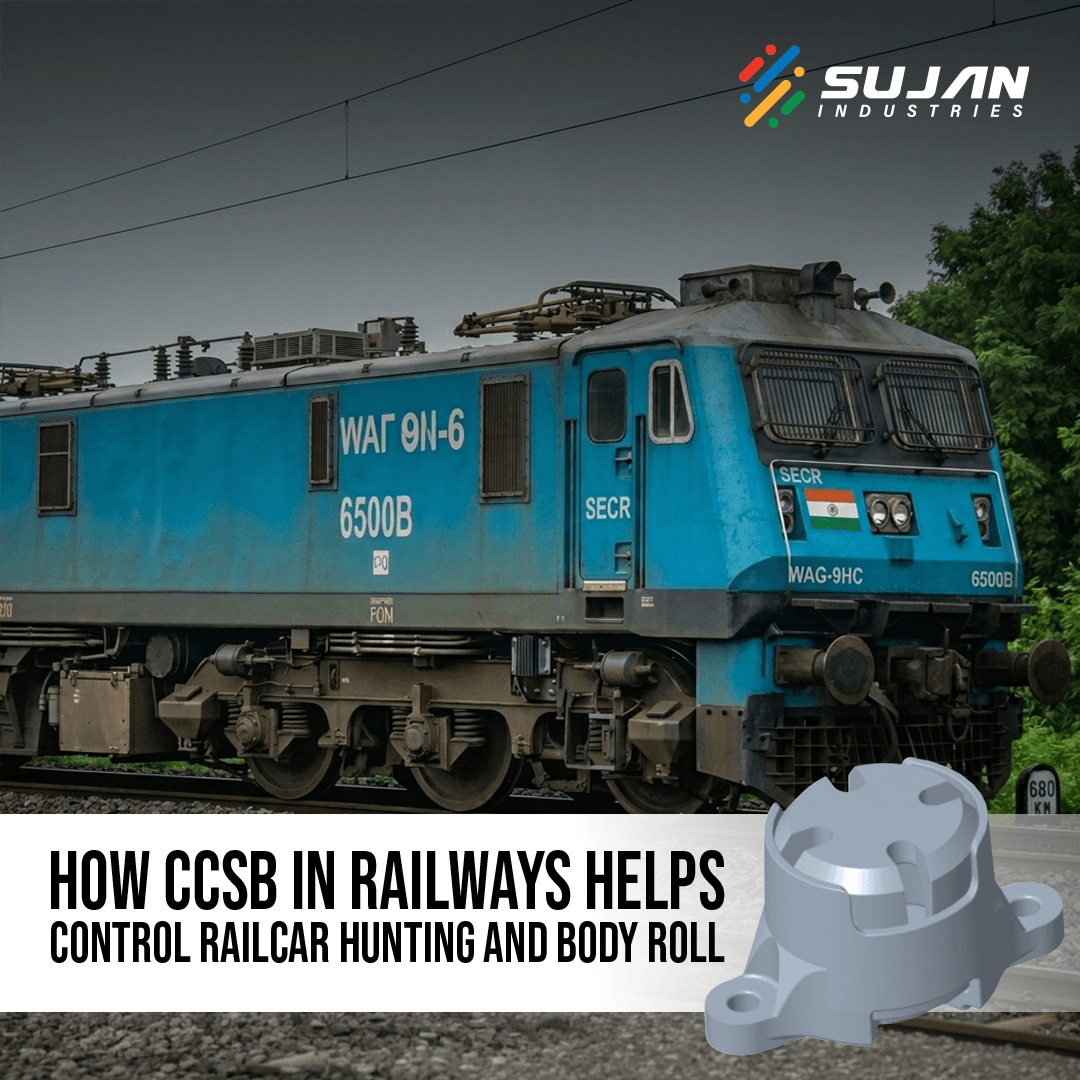
Railcars travel thousands of kilometres over uneven tracks, and small imperfections can quickly turn into big stability problems.
Constant Contact Side Bearers, or CCSB, are one of the quiet workhorses that keep a railcar’s truck assembly steady during this journey. This piece explains how CCSB in railways controls both hunting and body roll, and how this protects both the car body and the track itself, especially when speeds and loads increase.
A loaded railcar moving at speed puts constant lateral and vertical stress on its trucks. Left unmanaged, this stress shows up as railcar body roll, a rocking motion that develops when a heavily loaded car runs over an uneven roadbed. Over time, that rocking wears down bolster gibs and side frames, driving up maintenance costs and shortening component life.
That’s precisely where the role of CCSB in railways comes into play. Instead of allowing the collision of the car body and truck structure during the roll movement freely, a well-designed side bearer maintains constant contact between the two. Their work is to absorb energy instead of transmitting it into shocks and impacts. That constant, cushioned contact is the core idea behind the entire CCSB design.
A railway side bearer> sits quietly between the car body and the truck bolster, but its job is anything but minor. Here’s how they contribute to a smoother, safer ride.
A railway side bearer transfers lateral loads between the car body and the truck, keeping the two aligned as the railcar moves. Without it, even routine track curves and speed changes would translate into excess sway. Consequently, the bearer becomes a first line of defence against uneven wheel-rail contact.
Unlike older clearance-style bearers that only engage once movement has already begun, CCSB units maintain steady contact at all times. As a result, they respond to lateral forces the moment they appear, rather than after a jolt has already occurred. This proactive contact is what separates CCSB from traditional bearing designs.
By damping lateral movement continuously, CCSB units help the truck track the rail more predictably, even as speed increases. Furthermore, this steadier tracking reduces the wear that would otherwise concentrate on wheel flanges and rail heads. Over the life of a freight wagon, that translates into fewer unscheduled repairs.
Hunting is the cyclic, side-to-side yawing motion a truck develops once speeds climb, and it remains one of the toughest challenges in railcar hunting control for freight and passenger stock alike.
Helps reduce instability and hunting of trucks
CCSB units are built to offer exceptional control over truck hunting, letting railcars run faster with noticeably less wheel wear across a wide range of railcar components.
A 2024 study published in the journal Sensors found that hunting instability becomes a bigger concern once bogie components reach a wheel-wear level beyond 300,000 kilometers, making regular monitoring essential.
Body roll can look minor from the outside, yet it places real strain on the car body and the truck below it.
As a heavy car rolls side to side, the bearer compresses and resists that motion instead of letting it swing freely, protecting several other parts from unnecessary wear.
The curve causes additional lateral stresses, and dynamic loads create additional stress as well. The correct bearing will absorb such stresses gradually and not transmit them directly.
Here is a quick look at how railcar body rollconnects to side bearer performance.
| Movement or Condition | Potential Effect | Role of Side Bearer |
|---|---|---|
| Truck hunting | Lateral instability | Helps control unwanted truck movement |
| Body roll | Excessive rolling motion | Provides controlled resistance |
| Curves | Increased lateral forces | Supports controlled relative movement |
| High-speed operation | Greater dynamic forces | Helps maintain truck stability |
Choosing the right railway side bearer is not just about the part itself, since the material and testing behind it matter just as much.
Durable rubber compounds, reliable rubber-to-metal bonding, and tight dimensional accuracy all matter for demanding railway duty. Well-built metal components and casting work hold up far better under repeated stress than a poorly bonded part ever could.
Every application needs design work matched to its load and speed profile, backed by testing against recognized standards. Reliable CCSB products, for instance, are built to AAR M948 specifications for freight wagon components.
Read More – How Rubber Vibration Isolation Hangers Reduce Vibration in HVAC Systems
CCSB in railways works best only when it’s matched to the right axle load, speed range, and track condition, as this guide has covered through stability, hunting control, and body roll.
At Sujan Industries, our team builds side bearers around the specific demands of your railcars and offers only the components that fit your operation. With proven materials and testing, we help you get lasting performance and fewer breakdowns on the line.