



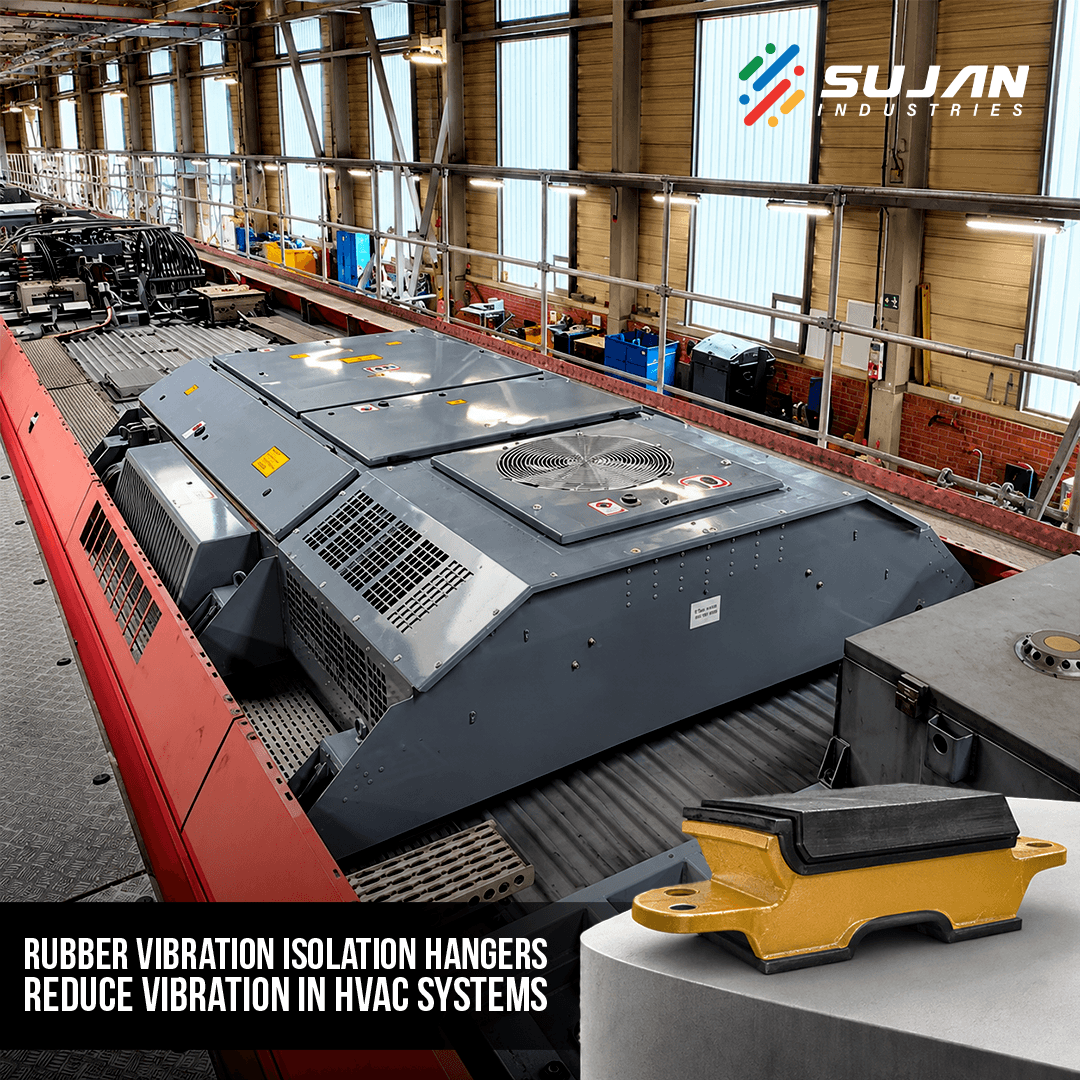
Does one small part quietly safeguard your heating and air conditioning system from damage over many years? Machines vibrate constantly while operating, but without some form of control, the wear and tear will occur at an unexpectedly accelerated rate.
That’s precisely the reason why more and more facilities in India are using vibration isolation hangers for their pumps, ducts, and suspended equipment to ensure smooth operation. This guide explains how these hangers work and why they matter.
Motors, pumps, and HVAC units almost never sit still while they’re doing their job. Every one of them shakes, hums, or shudders, and if nobody deals with that movement, it slowly turns into noise, wear, and stress on whatever structure is holding it up. This is where vibration isolation hangers earn their keep, catching that stress early before it works its way through pipes or ceilings.
Suspended HVAC systems have it worse than most, since vibration travels through metal ductwork almost as easily as sound moves through air. A well-built hanger cuts that path short, protecting both the equipment and the building underneath it. Once you get how these small parts actually work, choosing the right one stops feeling like guesswork.
Rubber sits inside these hangers and soaks up energy before it can travel through suspended equipment or the structure around it.
Rubber compresses and expands slightly when loaded, thus storing mechanical energy with each slight motion. That flexibility turns vibration into a bit of heat instead of letting it keep traveling.
A properly installed hanger breaks the direct link between vibrating equipment and everything around it. Far less energy ever reaches ceilings, walls, or nearby machinery because of that break.
Vibration and noise usually travel as a pair, so cutting one down tends to quiet the other automatically. Interrupt that path early enough, and the whole room just feels calmer.
Beyond the basic job of controlling vibration, good vibration isolators bring a handful of real, practical advantages to HVAC and industrial systems.
Stable mounting keeps rotating equipment properly aligned through hours of nonstop use. Over time, that stability alone can stretch out how long the internal parts actually last.
Isolators stop the vibration path before it ever gets near walls, floors, or ceilings. That matters a lot in hospitals, offices, and any other space where quiet actually counts for something.
Consistent isolation keeps unwanted movement out of fans, pumps, and compressors day to day. Equipment ends up running closer to how it was actually designed to perform.
Rubber vibration isolation hangers step in at more than one point while equipment keeps doing its thing.
The hanger meets equipment right where vibration first starts, at the mounting point itself. Catching it there stops it from ever building momentum further down the line.
Once vibration gets past that connection point, the hanger keeps it from reaching ceilings or overhead beams. Structures end up carrying a lot less repeated stress across months of use.
Left alone, vibration can match a structure’s natural frequency and snowball into resonance. Isolation hangers get in the way of that before resonance ever gets a chance to build.
Fans, compressors, and ducts all kick out mechanical noise just by doing their job. Hangers cut down how much of that noise actually makes it into the space below.
Stable suspension keeps HVAC components properly aligned through long stretches of runtime. Equipment holds closer to its intended efficiency for a lot longer as a result.
Picking the right hanger really comes down to a few practical things, not just price or whatever’s sitting on the shelf. IMARC Group projects India’s HVAC market to grow from USD 13.56 billion in 2025 to USD 49.02 billion by 2034, so getting this choice right matters more than it used to.
At Sujan Industries, the same thinking behind HVAC hangers shows up in a lot of other industrial and automotive systems too.
Anti vibration mountscarry floor-mounted equipment like generators, compressors, and heavy machinery bases. They rely on the same rubber-based absorption as hangers, just planted on the ground instead of hanging overhead.
A leaf spring shackle connects the leaf spring to the vehicle chassis while letting it flex under load. It does more or less what a hanger does, just without passing that stress straight into the frame.
A leaf spring hanger mounts the leaf spring securely to the chassis at a fixed pivot point. Get this one right, and ride quality and suspension durability both quietly follow.
Read More – The Role of Vibration Isolation Systems in Military Tanks: What Military Parts Suppliers Get Right
Picking the right vibration isolation hangers protects your equipment, cuts down noise, and stretches system life across HVAC and industrial setups, which is really what this guide has walked through from start to finish.
At Sujan Industries, we build rubber-based isolation solutions for tough industrial conditions. Our team stays with customers from material selection all the way through installation, so the performance holds up for years, not just months